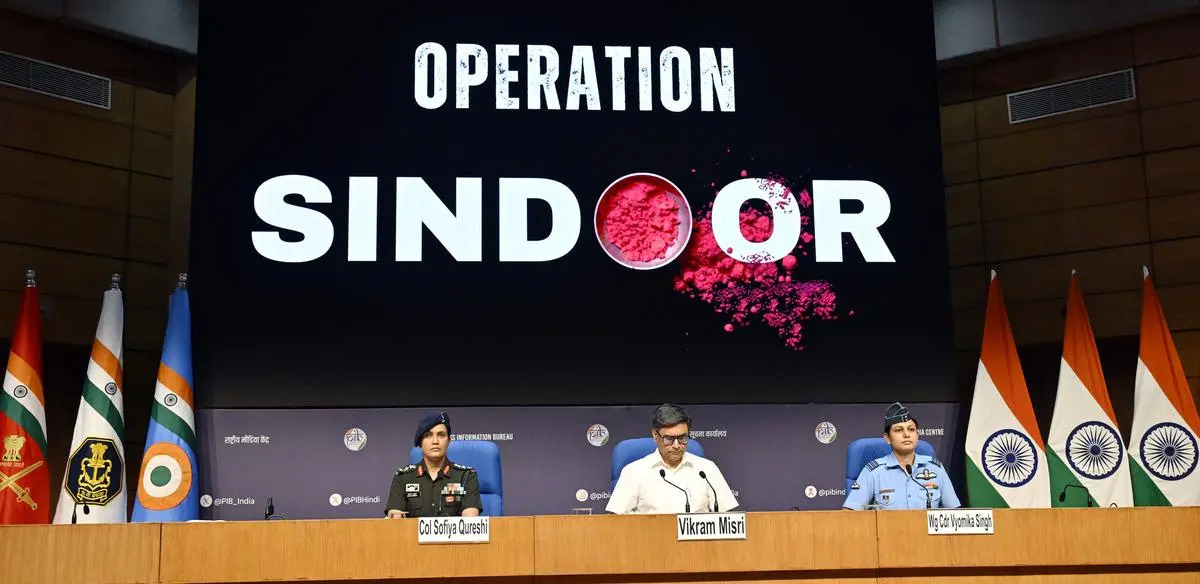
Operation Sindoor has emerged as a powerful example of how modern engineering challenges demand expertise across multiple disciplines, according to the Director of the Indian Institute of Technology Madras. Speaking about the operation, the IIT-Madras Director highlighted that as many as 10 to 11 different engineering fields were involved, reinforcing the institute’s renewed focus on interdisciplinary education.
“We are focusing on interdisciplinary education at IIT-Madras. Operation Sindoor is an example of this, as 10–11 disciplines of engineering were involved in that operation,” the Director said, underlining how complex national missions increasingly rely on integrated technological capabilities rather than siloed specialisations.
While specific technical details of Operation Sindoor remain limited in the public domain, the operation is understood to have required coordinated inputs from multiple branches of engineering. These likely included mechanical, electrical, electronics, computer science, aerospace, materials science, communication systems, and data analytics, among others. The successful execution of such missions depends on seamless collaboration across these domains, highlighting the evolving nature of engineering practice.
At IIT-Madras, this reality is shaping academic reforms. The institute has been expanding interdisciplinary programmes that allow students to work at the intersection of traditional departments. New curricula encourage engineering students to combine core technical knowledge with exposure to artificial intelligence, robotics, cybersecurity, and systems engineering, preparing them for real-world challenges that do not fit neatly into a single discipline.
The Director emphasised that interdisciplinary learning is no longer optional but essential. Defence operations, infrastructure projects, space missions, and climate-focused technologies increasingly require engineers who can communicate across domains and integrate diverse systems into a unified solution. Operation Sindoor, he noted, demonstrated how such integration can be critical to mission success.
India’s higher education ecosystem has been gradually moving in this direction, with leading institutions aligning their programmes with national priorities in defence, manufacturing, and technology self-reliance. IIT-Madras has positioned itself at the forefront of this shift, promoting collaborative research centres and industry-linked projects that expose students to complex, multi-disciplinary problems early in their careers.
Education experts say such an approach not only improves employability but also fosters innovation. Engineers trained in interdisciplinary environments are better equipped to adapt to emerging technologies and solve large-scale problems. The lessons drawn from Operation Sindoor underscore how academic training can directly influence national capabilities.
By citing a real-world defence operation, the IIT-Madras Director linked classroom learning with practical impact, offering a compelling argument for rethinking engineering education in India. As technological challenges grow more complex, interdisciplinary education is increasingly being seen as the foundation for future innovation, national security, and technological leadership.

Note: Content and images are for informational use only. For any concerns, contact us at info@rajasthaninews.com.

Previous Post
Next Post
"हाईकोर्ट ने प्राइव...
Related Post