
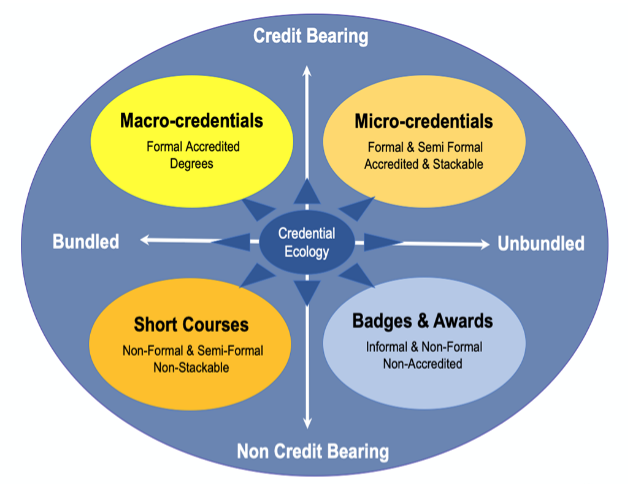
Traditional university degrees in arts, science, and engineering are facing a growing credibility challenge in today’s rapidly evolving job market. While these degrees continue to provide foundational knowledge and academic depth, employers increasingly seek job-ready skills that graduates often lack. Micro-credential courses are emerging as a powerful solution to bridge this widening gap between education and employability.
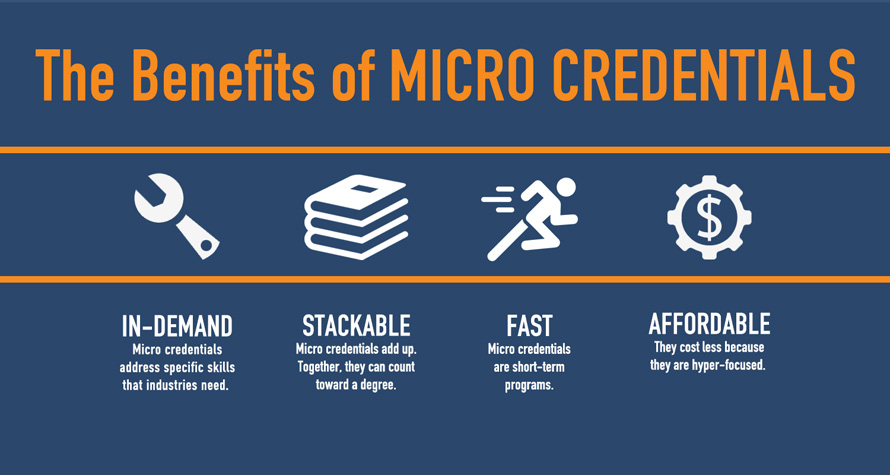
Micro-credentials are short, focused learning modules designed to teach specific, industry-relevant skills. Unlike full-length degree programs, they are flexible, quickly updatable, and closely aligned with real-world demands. When integrated into arts, science, and engineering curricula, micro-credentials can significantly enhance the value of traditional degrees without replacing them.
For arts and humanities students, micro-credentials can introduce practical skills such as digital storytelling, content strategy, data visualization, UX writing, or cultural analytics. These skills help graduates translate critical thinking and communication abilities into tangible workplace competencies. By pairing theory with applied learning, arts degrees can better demonstrate their relevance in sectors like media, marketing, public policy, and creative industries.
In science disciplines, micro-credentials can keep pace with fast-moving fields such as data science, bioinformatics, climate modeling, and laboratory automation. Scientific knowledge evolves rapidly, and short credential courses allow students and professionals to update their skills without returning to full-time education. This ensures science graduates remain competitive in research, healthcare, environmental science, and technology-driven roles.
Engineering education stands to gain significantly from micro-credentials as well. While core engineering principles remain essential, employers increasingly demand proficiency in tools, software platforms, and interdisciplinary skills such as AI integration, cybersecurity, project management, and sustainability engineering. Micro-credentials enable engineering students to specialize, diversify, or reskill as industries evolve.
One of the strongest advantages of micro-credentials is their responsiveness to industry needs. Universities can collaborate with employers to co-design courses, ensuring relevance and credibility. Digital badges and certificates also offer transparent proof of skills, making it easier for recruiters to assess a candidate’s capabilities beyond degree titles.
Importantly, micro-credentials can help modernize higher education without undermining academic rigor. Degrees provide intellectual depth, critical thinking, and disciplinary grounding, while micro-credentials add adaptability and applied expertise. Together, they create a more holistic educational model—one that values both knowledge and skills.
As automation, artificial intelligence, and global competition reshape the workforce, the future of higher education lies in flexibility and lifelong learning. Micro-credential courses offer a practical path forward, helping arts, science, and engineering degrees stay relevant, resilient, and respected. Rather than signaling the decline of traditional degrees, micro-credentials may be the key to preserving and strengthening them in a rapidly changing economy.
Note: Content and images are for informational use only. For any concerns, contact us at info@rajasthaninews.com.

Previous Post

Next Post
"हाईकोर्ट ने प्राइव...
Related Post