
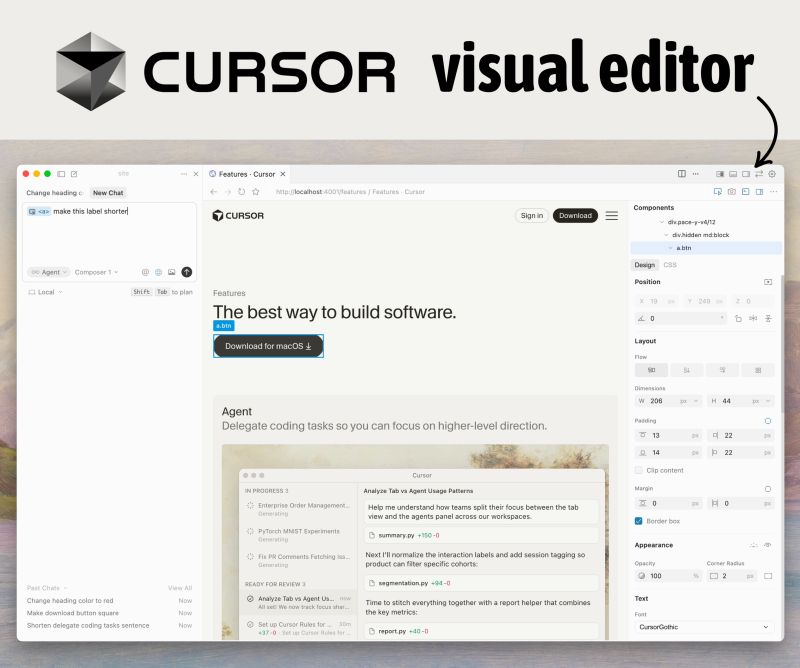
Cursor has officially launched its Visual Editor, a powerful AI-driven agent tool that expands its popular “vibe-coding” philosophy into full-fledged web app design. With this release, Cursor moves beyond text-based prompts and code suggestions, offering developers a more intuitive, visual, and interactive way to build and refine user interfaces.
The Visual Editor enables developers to drag and reposition elements directly on a live web app, inspect components and their props in real time, and request changes using natural language while pointing and clicking on the interface. Instead of manually hunting through component files or tweaking CSS line by line, developers can now interact with the UI visually and let Cursor’s AI translate those actions into precise code updates.
This approach addresses one of the biggest pain points in modern frontend development: the constant context switching between design tools, browser dev tools, and code editors. Cursor’s Visual Editor brings these workflows together into a single environment, making UI iteration faster and more natural. Whether adjusting spacing, modifying component properties, or reworking layouts, developers can see changes instantly and maintain a smooth feedback loop.
At the heart of this feature is Cursor’s concept of vibe-coding, which focuses on expressing intent rather than writing every detail manually. With the Visual Editor, that intent is no longer limited to text prompts. Visual context—where a component is, how it looks, and how it behaves—helps the AI understand developer requests more accurately. For example, a user can click on a card component and say, “Increase padding, round the corners more, and align this to the center,” and the AI will handle the underlying implementation.
The Visual Editor is particularly valuable for web app design and frontend-heavy projects, where layout, styling, and component structure are just as important as business logic. It lowers the barrier for developers who may not be experts in CSS or complex component hierarchies, while still preserving the flexibility and control that experienced engineers expect.
From a product development standpoint, this feature is well-suited for rapid prototyping, MVPs, and iterative design workflows. Solo founders, startups, and small teams can move from idea to polished interface faster, without relying heavily on separate design-to-development handoffs. It also complements existing component-based frameworks by making inspection and modification more accessible.
More broadly, Cursor’s Visual Editor reflects a larger shift in AI developer tools—from passive assistants that suggest code to active agents that collaborate with developers. By combining visual manipulation, conversational commands, and code generation, Cursor is positioning itself at the forefront of this new generation of development environments.
With the launch of the Visual Editor, Cursor is signaling that the future of web development lies in visual, intent-driven collaboration with AI, where designing and coding happen side by side, and developers can focus more on creativity and product thinking than on repetitive implementation details.
Note: Content and images are for informational use only. For any concerns, contact us at info@rajasthaninews.com.
Previous Post
Next Post
TSMC Optimistic Amid...
Related Post